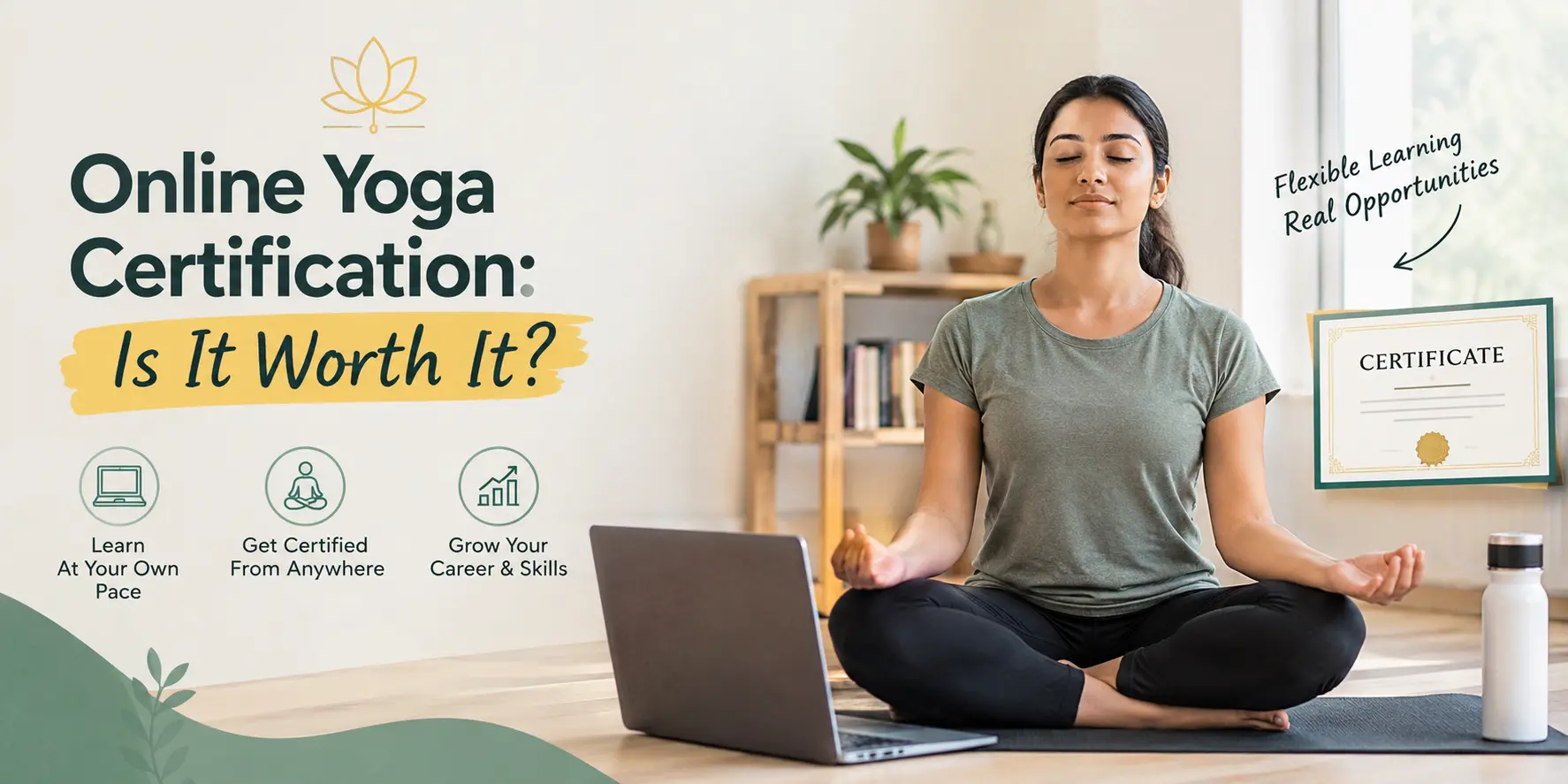
At some point in a regular practice, a lot of people have the same thought: should I get certified? Maybe you want to teach. Maybe you just want to understand yoga more deeply. Then you search for options and find dozens of online yoga teacher trainings, with prices that range from suspiciously cheap to genuinely expensive, and every one of them promising to change your life.
So is online yoga certification worth it? For some people, yes. For others, it's an expensive way to avoid a simpler answer. Here's how to work out which group you're in.
What "Certification" Actually Means
This is where most of the confusion starts, so it's worth being precise.
- A certificate from a school means you completed that school's course. The value depends entirely on the school.
- Yoga Alliance registration is different. Yoga Alliance is a registry, not a government regulator. To become a Registered Yoga Teacher (RYT-200, for example), you generally need to complete training with a school that is itself registered with them.
- A license to teach isn't generally required by the government in the US. That said, many studios and insurance providers do ask for a recognized credential such as RYT-200 before they'll hire or cover you.
So "certified" can mean very different things depending on who is saying it. Always ask: certified by whom, and can I verify it?
When Online Certification Is Worth It
Online training makes sense in a few situations:
- You want to teach, and you need the credential. If studios or insurers in your area ask for RYT-200, a registered program is the practical route.
- You want to teach online. Learning in the format you'll teach in is a real advantage.
- You need flexibility. Work, family or location may rule out a month-long in-person course.
- You want to deepen your own practice. Many people take a training with no plan to teach, and find it valuable on those terms.
When It Probably Isn't
- You mainly want to practice. A good set of regular classes costs far less and gets you the same benefit.
- You've only been practicing a few weeks. More on this below.
- You're hoping certification will fix a lack of confidence. It usually won't. Teaching confidence comes from actually teaching.
- The program is the cheapest thing you could find. Price isn't proof of quality, but bargain-bin pricing is often a sign of thin content.
How to Tell If an Online Program Is Legitimate
Before paying anyone, check these:
- Verify the registration yourself. If a school says it's registered with Yoga Alliance, look it up in their public directory. Don't just take the website's word for it.
- Look for live interaction. Training that is entirely pre-recorded, with no live sessions or feedback from a trainer, is much weaker. Teaching is a skill you learn by being observed and corrected.
- Find out who the trainers are. Real programs name their lead teachers, share their backgrounds and years of experience.
- Be wary of guarantees. "Certified in a weekend", "guaranteed pass" and "100% approval" are red flags. A real course has real assessment.
- Read the refund and cancellation terms before you pay, not after.
- Ask about practice teaching. You should be teaching other people during the course, not just watching lectures.
- Check the hours. A 200-hour program means 200 hours of real contact and study time. If the schedule doesn't add up, ask why.
Rules and standards can change, so check Yoga Alliance's own website for their current requirements on online delivery before you enroll.
The Commitment Question
Be realistic about what a 200-hour training asks of you. Spread over weeks or months, it usually means several hours of study and practice a week, plus live sessions, assignments and practice teaching. Self-paced programs are more flexible but easier to abandon. If your week is already full, that matters more than the price.
Cost varies widely, from a few hundred dollars to a few thousand. Don't compare only the price tag. Compare what you actually get: live hours, trainer access, feedback, and whether the registration is real.
Start With Online Yoga Classes for Beginners
Here's the advice most training providers won't lead with: don't pay for certification until you've practiced for a while. Many schools recommend roughly six months to a year of regular practice first, and it's good advice.
The reason is simple. A training course assumes you already know the poses, understand how your own body moves and enjoy the practice enough to spend months on it. If you're brand new, you'll spend the whole course catching up on basics instead of learning to teach.
Taking online yoga classes for beginners first gives you three things for free that a training can't:
- Proof that you actually like yoga. Ten weeks of regular classes will tell you more than any brochure.
- A feel for what good teaching looks like. When you've been taught well, live, with corrections, you know what you're aiming for.
- A base to build on. Two to three classes a week is a sensible rhythm for most people who are starting out.
If you're new, start with our guide to 12 basic yoga poses for beginners and why Hatha is a good style to start with. If you're weighing up cost as well, free vs paid online yoga explains how to decide.
A Simple Way to Decide
Ask yourself three questions:
- Do I want to teach, or do I mainly want to practice?
- Have I practiced regularly for at least six months?
- Can I realistically commit the hours every week?
If the answers are "teach", "yes" and "yes", then a verified, registered, live online training can be worth it. If any answer is "no" or "not sure", the better move is more classes first and certification later.
Where to Start
Namho Yogis' live online classes are taught by Yoga Alliance-certified instructors trained in Rishikesh, India, in small groups with real beginner-paced options, scheduled across EST, CST and PST. There's a free trial, so you can see how a live class feels before you commit to anything.